Showing posts with label coronavirus. Show all posts

Monday, August 9, 2021

Covid vaccines, beneficiaries of "advances in technology, data mining, and data modeling."

Retort to the mounds of misinformation around Covid vaccines by the inimitable Scott Galloway.

"...But the swiftness with which the vaccines have been developed is less a reflection of haste than of commitment, resources, and new technology.


As of mid-December, scientists had published 74,000 papers related to a virus that nobody had heard of 12 months earlier. Nearly one-third of all scientific researchers around the world have dropped their prior projects to work on Covid-related matters. As Ed Yong recently described in the Atlantic, this pivot is far beyond any historical precedent and will have profound effects on the scientific community for years to come.


The speed of clinical trials can also be attributed to the virus’s very virulence, as it takes so little time for the control group to suffer a statistically significant number of infections. Johnson & Johnson recently cut the size of its Phase 3 trial because infection rates are so high in the U.S.


We moved fast because we had to, and because we could. These vaccines benefited enormously from advances in technology, data mining, and data modeling.


The technology behind the Pfizer and Moderna vaccines, which has been in development for decades, also enabled the shots to reach us quickly. Their novel deployment of messenger RNA should also quell a common concern about vaccines: that they inject a modified form of the virus itself into the recipient. Instead, mRNA vaccines provide the “instructions” our immune system needs to identify and defeat the pathogen. They do not alter the DNA in our cells. (If my scientific expertise is not reassuring on this point, vaccines based on traditional approaches are also in development.)


Still, though, I hear friends and colleagues say, “Even if the risk is tiny, why take it? I’m not at risk from Covid.” But the risk of suffering serious health effects from the disease, even for younger people in good health, is real. In July, the death rate among adults 25-44 was almost 50% higher than in July 2019 — that’s an additional 5,000 deaths attributed to Covid, among younger people, in just one month. Even among survivors, the virus has been shown to cause long-term neurological and cardiac harm in 10% of victims. Yes, the risk is small. But it’s far greater than the risk presented by the vaccine.


Whatever the risk to ourselves, however, we don’t take vaccines only to protect ourselves. We take them to protect everyone, to avoid becoming a fiber in the web."


Friday, January 8, 2021

Causes and implication of the pandemic increase in house prices

Harvard Joint Center for Housing Studies fellow Don Layton's excellent summary of the state of play in pandemic-era US residential housing. Key point, don't expect a replay of the Great Recession with its Ownership Society hangover from binging via loose lending standards and the use of “house as piggy bank” which led to a foreclosure crisis and 1-in-4 homes being underwater. We will surely face headwinds in the days ahead, but gross pattern-matching will not provide the right insights.

Saturday, November 28, 2020

Disparate outcomes of loan deferral/forbearance programs

The Wall Street Journal highlights the disparate outcome of loan deferral programs set out by the Cares Act, which have been "of greater benefit to homeowners and college graduates, many of whom entered the recession in relatively good financial shape. Lower-income workers, who are more likely to rent and to not have a college degree, saw less benefit."

In a fractal turn within mortgages, one sees a marked divergence in impact, with the Federal Housing Administration and U.S. Department of Veterans Affairs loans having 2.6x higher rate of forbearance than the generally better credit Fannie Mae and Freddie Mac loans. (Source: Black Knight McDash Analytics)

Wednesday, November 18, 2020

Pandemic mobility: "Well... how did I get here?"

There's a sense that, once this pandemic subsides, many of us will be living that Talking Heads classic with the refrain stuck on repeat. LendingTree recently announced 46% of its mobility survey respondents are considering moves over the coming year. One in five are thinking out-of-state, so it's more tweaking than migration.


Just as interesting... 38% had changed living arrangements due to the pandemic. For men, it was nearly half.

Thursday, September 3, 2020

Zillow: Rental concessions on the rise

“Concessions can often be a leading indicator of a coming price drop in that landlords will often offer them first, before reducing rent.”

The percentage of rental listings with concessions nearly double between February and July as annualized rent growth drops by 75% over the same period, but situation is disproportionately impacting multifamily rentals common in urban cores.

“Renters in multifamily and other home types are more likely to receive some sort of concession than those in single-family rentals: 63% of multifamily renters report getting at least one, as do 59% of renters in other home types. Only 35% of single-family renters reported receiving any concessions.”

Recovery in employment rates since March/April

  1. Yet more data points for those wondering why housing and equities have been on such a tear of late.
  2. Clear correlation between CARES stimulus and a meaningful steadying of the economy

Source: Opportunity Insights

Friday, August 28, 2020

Has the Mid-Atlantic been gaining?

While The Brookings Institution piece focuses on how the Sunbelt’s coronarvirus surge is stalling that region’s economic recovery, I was just as interested by how the illustration of the change in volume of job postings in July seems to show that the big scale gainers are the Mid-Atlantic region, especially the New Jersey-Virginia coastal corridor, and Florida.


Saturday, May 23, 2020

Capital seeking title and closing innovations

News of an aggregate $152 million raised by States Title and Spruce is further indication that title and closing, what’s generally seen as the mundane portions the #mortgage process, has been receiving an excess of attention in the age of #coronavirus-driven social distancing and the resulting need for digital, virtualized transactions. 

Sunday, May 17, 2020

Online lenders battered by Coronavirus crisis

Online consumer and small business lenders facing challenges from all fronts

Funding has been problematic...
“Because these companies operate outside of the banking industry, they have never been able to turn to deposits as a stable source of loan funding. Instead they have relied heavily on alternative sources of liquidity — securitization markets, hedge funds and other private investors — that skeptics warned were likely to dry up during the next crisis.”
Also facing consumers that are behaving very conservatively: (1) not borrowing at previous levels; coming into this crisis with a 27% lower debt as portion of income than at the start of the Great Recession, and (2) saving record amounts, with 30% of consumers depositing their stimulus checks in savings and 25% using the checks to deleverage.

Whither #strategicDefault, the #credit bugbear this time around will likely be #strategicDelinquency

For further details, take a look at the #GoingConcern note in OnDeck’s latest 10Q.

No alt text provided for this image

First American: What a service sector-driven recession means for homeownership demand

First American’s Odeta Kushi delves into why “the pool of potential home buyers may not shrink as much as the jobless claims and unemployment rate may suggest” by examining #homeownership rates in the group most ‘vulnerable’ to the service sector-driven job losses. As the chart shows, even at its current lows, the homeownership delta between non-vulnerable and ‘vulnerable’ is slightly over 50%. While this #coronavirus-driven recession will certainly cause substantial pain across our entire economy, she puts forward a reasonable argument that this will “unlikely to result in a one-to-one decline in homeownership demand.”
a close up of a graph

Thursday, April 30, 2020

Consumer spending plummets

Consumer spending trends amidst the #covid19 pandemic. Great analysis from Joint Venture Silicon Valley leveraging Earnest Research data. While location-focused, the analysis clearly shows that the region has been a leading indicator for the rest of the nation. Key nugget: if shifts in consumer spending trends persist, upwards of 16% of the region’s total employment, across retail, hospitality and food services, could be at risk.
Aggregate Consumer Spending Compared to Prior Year - Week ending April 15, 2020

Sunday, April 5, 2020

Standing on the Precipice?

"The administration, Federal Housing Finance Agency, and regulators have put policy in place that could wreak long-term havoc on the entire #mortgage market if they don’t finish what they started." (David Stevens on Housingwire)
The unintended consequences of a "trust, but don't verify" mortgage forbearance policy include: (1) a liquidity crisis as mortgage servicers must continue to make good on the principal + interest payments to investors, not to mention property taxes, insurance and sundry other payments; (2) the disappearance of mortgage options for consumers as the originators, wary of moral hazard attendant to the forbearance policy, vacate large swaths of the market; and (3) the post-forbearance period crisis when home owners, stretched during the best of times, must somehow make good on the forborne portions.

It's as if the policy makers are now determined to achieve victory in the last war, one that emanated outward from the housing balance sheet, causing a lasting crisis of solvency.  This coronavirus pandemic is driving a crisis of liquidity as incomes evaporate, but if policy makers don't finish what they started, we may be revisiting the long-tenured morass from the last period.

Monday, March 30, 2020

Texas exceptionalism (and not in a good way)

“You can’t manage what you can’t measure” 
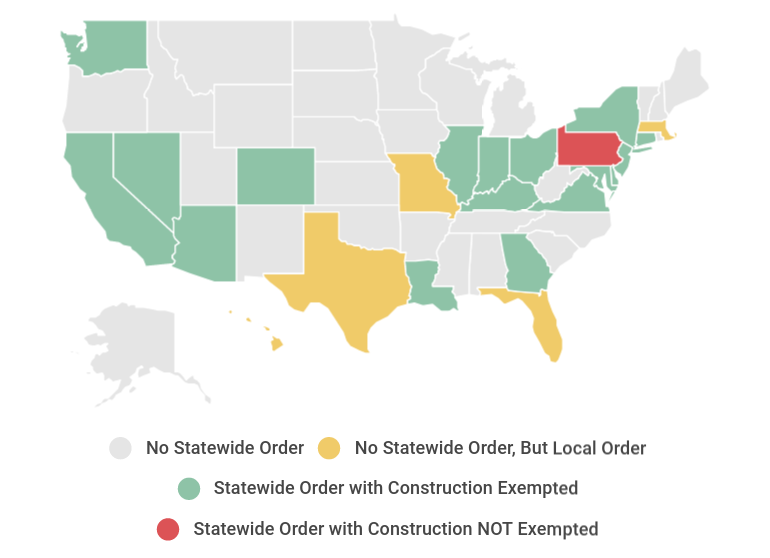
This apocryphal quote, variously attributed to Deming or Drucker, has gotten a bad rap in management circles for its inherent cognitive tunneling.  In the case of the COVID19 pandemic. there’s a massive amount of truth since we’re essentially flying blind.  Especially in Texas (source: Texas Monthly)
Image

Thursday, March 26, 2020

HEB > CDC/FDA/FEMA...

How did Texas-based HEB get the jump on COVID19? By reacting to the information coursing thru its supply chain early, by leveraging global partners in China, Italy to inform preparations, and by embracing community as a key constituency

Wartime CEO

Must read tweet stream from Stewart Butterfield of Slack (via Scott Galloway)


Title courtesy of Ben Horowitz. 

Monday, March 23, 2020

Coronavirus accelerating the digital transformation of house hunting

"Redfin saw a 494% increase in requests for agent-led video home tours last week... As of yesterday, 18.9% of tour requests made on http://Redfin.com were video-chat tour requests, up from 0.2% at the beginning of March"

Monday, February 3, 2020

Is the US prepared for the Coronavirus?

"In 2018, the Trump administration fired the government’s entire pandemic response chain of command, including the White House management infrastructure.” (Foreign Policy)
According to Foreign Policy, the actions taken to essentially gut the reforms to epidemic response made by the Obama administration in the aftermath of the faults made apparent by our handling of the 2014 Ebola outbreak will likely impair our ability to react to the emerging likely pandemic in a coordinated manner.  These actions have included:
  1. Reducing $15 billion in national health spending and cutting the global disease-fighting operational budgets of the CDC, NSC, DHS, and HHS.
  2. Eliminating the $30 million Complex Crises Fund.
  3. Ordering the shutdown of the NSC’s entire global health security unit.  Pressured DHS epidemic team to resign.  “Neither the NSC nor DHS epidemic teams have been replaced.”
  4. Cutting the global health section of the CDC so “that much of its staff was laid off and the number of countries it was working in was reduced from 49 to merely 10.”
Moreover, the US Agency for International Development (US AID) has come under repeated fire from both the White House and Secretary of State Mike Pompeo. And while Congress has so far managed to block Trump administration plans to cut the US Public Health Service Commissioned Corps by 40%, the “disease-fighting cadres have steadily eroded as retiring officers go unreplaced.”

The administration’s actions on this front sound distressingly familiar, a government led by the “uninterested,” as chronicled by Michael Lewis’s book, The Fifth Risk.

...Or one where political machinations are primary drivers of action, as demonstrated by the imbroglio over the phantom Alabama leg of Hurricane Dorian.