Monday, March 30, 2020

Texas exceptionalism (and not in a good way)

“You can’t manage what you can’t measure” 
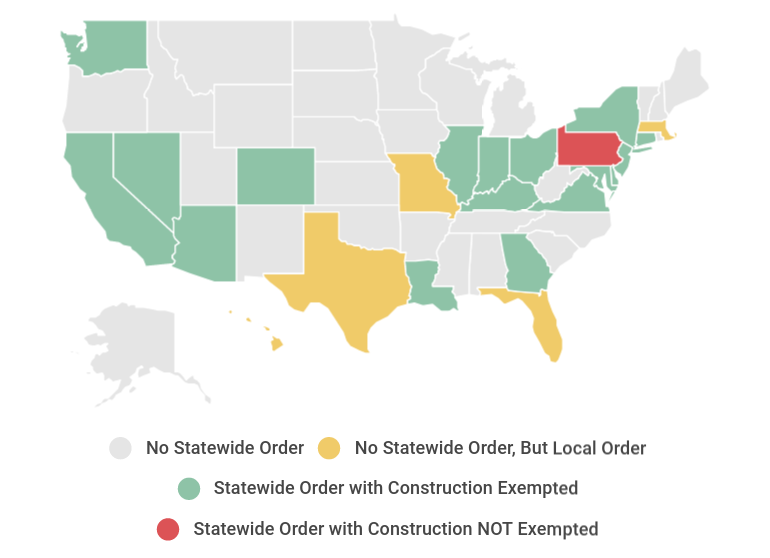
This apocryphal quote, variously attributed to Deming or Drucker, has gotten a bad rap in management circles for its inherent cognitive tunneling.  In the case of the COVID19 pandemic. there’s a massive amount of truth since we’re essentially flying blind.  Especially in Texas (source: Texas Monthly)
Image

Friday, March 27, 2020

Politico: The next financial crisis: A collapse of the mortgage system

“The mortgage market is one of the many multiple complexly interconnected pieces of our financial system, so those assurances (note: bank-provided credit facilities) are really important, but I think the role of the government in being a reliable and available source of credit for the mortgage market and mortgage servicers during a crisis is even more important.” — Margaret Liu, Conference of State Bank Supervisors (CSBS) senior vice president and deputy general counsel.

Those in control seem to be busy fighting the last war, applying those lessons learned in blazing speed with insufficient consideration that mortgage servicing is now dominated by non-banks.  What was a very unpleasant drag to returns for the banks in the prior crisis is now an existential threat for the entire system this go-around.
The Maginot Line – 11 Fascinating Facts About France's Great Wall ...

Thursday, March 26, 2020

HEB > CDC/FDA/FEMA...

How did Texas-based HEB get the jump on COVID19? By reacting to the information coursing thru its supply chain early, by leveraging global partners in China, Italy to inform preparations, and by embracing community as a key constituency

Zillow’s coronavirus playbook

"On the call, Rich_Barton revealed that Zillow will slash expenses by 25% this year; freeze hiring across the company; cut nearly all marketing spend; and suspend home-buying through its Zillow Offers business."

Wartime CEO

Must read tweet stream from Stewart Butterfield of Slack (via Scott Galloway)


Title courtesy of Ben Horowitz. 

Monday, March 23, 2020

Coronavirus accelerating the digital transformation of house hunting

"Redfin saw a 494% increase in requests for agent-led video home tours last week... As of yesterday, 18.9% of tour requests made on http://Redfin.com were video-chat tour requests, up from 0.2% at the beginning of March"

More non-QM trouble

Angel Oak and Citadel Servicing have halted Non-QM lending.

Flagstar cutting back on warehouse lending

Flagstar Bancorp, one of the nation's biggest warehouse lenders to mortgage providers, has stopped funding most new home loans without government backing.

Non-QM and iBuying as canaries in the coalmine

Further sign of a liquidity crisis in the housing finance market - a system-wide retrenchment in Non-Qualified Mortgage originations with major originators in the segment shutting down production.

Those considering Non-QM loans risky and are saying "good riddance," are missing the forest for the trees as non-banks dominating housing finance rely on interim funding as working capital since they lack access to the permanent capital available to banks.

Together with iBuyers, which have suspended their purchases en masse, these two are the veritable tide pools of the housing finance ecosystem, teaming with innovation, yet most exposed when the tides turn. While it's comforting that the Federal Reserve Board is now deploying an unlimited checkbook towards quantitative easing, the administration's erratic actions and Trump's deep antagonism towards Powell is depriving the market of something just as critical - confidence.

This recalls the book "The Confidence Game" written 25 years ago at the zenith of the independent central banker with the author positing that "central banks are the sole institutions capable of maintaining a global system of checks and balances."

Wednesday, March 11, 2020

Creating an Innovation API to scale up collaborations

Great example of the Innovation API I’ve advocated for so that financial services incumbents can shape collaborations with #intech at scale in a mutually beneficial manner.

The rapid proof of concept (RPOC) was developed in 2019 to “to speed up how quickly the CIB could decide if it wanted to work with a fintech” from months to weeks.  Components include: streamlined documentation needs, standardized NDAs, “fintech-friendly” evaluation agreements, and synthetic datasets in an AWS sandbox.

"One of our goals is to partner more and work with the fintech community to build an innovative ecosystem" - Michael Elanjian, head of digital innovation at J.P. Morgan’s Corporate and Investment Bank.

Tuesday, March 10, 2020

Digital transformation of mortgages (v.Next)

“...the surging demand (for mortgages) will likely overwhelm parts of the process and all lenders' turn times will probably lengthen”

While most leading mortgage originators have invested in or partnered with fintechs to upgrade their digital mortgage capabilities, these “upgrades have primarily streamlined only the early stages of the notoriously complicated and paper-heavy mortgage process.” Processing, underwriting, appraisals, home inspections, and closings still involve substantial human effort.

How will we, as an industry, reconcile the strategic imperative to continue our digital transformation, which is still clearly in the early innings, with this bounty of production in a way that prioritizes customer experience?

Tuesday, February 25, 2020

HBR: Are Your Company’s Leaders and Data Scientists on the Same Page?

“Unfortunately, what’s far more common is misalignment between expectations at the top of the organization and the foundation of what data science can realistically deliver. The best mental picture of this dynamic is an inverted pyramid. The wide top reflects the C-suite’s oversized expectations for data science impact. The small point at the bottom represents the data science team’s current capabilities, which are often far more modest and develop over time.” (from HBR)

Saturday, February 22, 2020

Something fishy with Zillow's revenues

Great analysis by Mike DelPrete.  It’s as if an investment bank reported revenues based on the gross value of securities sold through its brokering business.  Another sleight of hand relates to ‘holding cost’ since the reported amount ‘excludes expenses incurred during the period that are not related to homes sold during the period.’  The good news is that Zillow sold 115 more homes than it bought in 4Q19; the bad news that ended 2019 having bought 2,198 more homes than it sold.  What’s clear is that the company’s balance sheet has changed dramatically, with Inventory ending the year at 13.6% of assets, up from 3.8% at 2018 year-end.  Since the $1.5B of credit facilities is already at 46% utilization, I’d keep a close eye on the velocity of homes inventory in 2020.  Zillow may discover that what they thought was a ‘shipping’ business was, in fact, a ‘storage’ business.

LendingClub's acquisition of Radius Bank

“The monoline marketplace lender model is a dead end for fintechs and they know it.”

Comprehensive analysis by Todd Baker on the LendingClub Radius Bank, hitting on all the issues that surfaced when we investigated making a push into personal loans a while back.

"It’s impossible to build a consistently profitable and resilient business without providing customers with a broader range of products and services--with their attendant revenue streams. There just aren't enough savings from automation to make up for lost revenues and financial intermediation costs."

Friday, February 21, 2020

Is Zillow in the shipping or storage business?

Much ink has already been spilled about the losses racked up by Zillow as it aggressively grows  revenues from its Homes segment.  Mike DelPrete further points to how the reported revenues are misleading because its basis is that of the home sale price.  It’s as if an investment bank reported revenues based on the gross value of securities sold through its brokering business.

Another sleight of hand relates to ‘holding cost’ since the reported amount ‘excludes expenses incurred during the period that are not related to homes sold during the period.’  The good news is that Zillow sold 115 more homes than it bought in 4Q19; the bad news that ended 2019 having bought 2,198 more homes than it sold.

What’s clear is that the company’s balance sheet has changed dramatically, with Inventory ending the year at 13.6% of assets, up from 3.8% at 2018 year-end.  Since the $1.5B of credit facilities is already at 46% utilization, I’d keep a close eye on the velocity of homes inventory in 2020.  Zillow may discover that what they thought was a ‘shipping’ business was, in fact, a ‘storage’ business.

Tuesday, February 18, 2020

More on The Economist's year of residential real estate...

"In the 1950s, 20% of households in a county moved each year. Today 9% do."  This one point about the decreased mobility of Americans may explain why The Economist seems to have made 2020 thus far its "Year of Residential Real Estate."  What’s evident is the publication sees real economic and societal costs from the ossification of “world’s biggest asset class,” abetted by government actions that have rendered an obsession for home ownership its “biggest economic policy mistake.”

The problem is that the US has some of the highest real estate commissions in the world, and antiquated "rules on commissions and data-sharing have so far kept fees higher than in other rich countries."

Thus begins the newspaper's the latest piece around real estate, about how "technology is poised to upend America's property market."

Sunday, February 16, 2020

Glengarry Glen Ross in Mortgages 2019

The mortgage sector rocketed to a close in 2019 with $2.4 trillion of total production (up 46% year-over-year).  The recent trends of increased concentration at the top and the rise of the non-bank originators continue, with the Top 25 accounting for nearly 60% of the market (up 2 points) and non-banks accounting for 57% of that cohort (up 7 points).

Glengarry Glen Ross"...first prize is a Cadillac Eldorado... Second prize is a set of steak knives. Third prize is, you’re fired.” (Alec Baldwin as Blake, Glengarry Glen Ross)
Just as important for the non-banks is the "Glengarry Glen Ross" nature of the competition.  In the past year, the top three non-banks (Quicken, PennyMac, United Wholesale Mortgage) accounted for 38% of the increased production amongst the entire Top 25, growing at 2.4x the rate of others in the cohort.

How did they do that?

Each of the top three non-banks have spent the better part of the past decade creating substantial technology platforms that seems to have able to mitigate the capacity constraints that have traditionally characterized US mortgage lending.  A 2018 study by the New York Fed ("The Role of Technology in Mortgage Lending") provides some some early intel on this topic.  In assessing the role of technology in mortgage lending, the study found that lenders whose business model incorporates "an end-to-end online mortgage application platform and centralized mortgage underwriting and processing augmented by automation" were able to "respond more elastically to changes in mortgage demand."

It further found that a doubling of application volume raises loan processing time by 13.5 days for traditional lenders, compared to only 7.5 for technology-enabled ("FinTech" in the study), with reduced denial rates,"suggesting that their faster processing is not simply due to credit rationing during peak periods."

The data set used in this study spanned 2010 through 2016, suggesting that these advantages would have increased substantially with the tech maturation of the past few years.

What does this mean for the rest?

Image result for grasshopper ant fableFocusing on the field of non-banks below the top three (the "herd") for the moment since banks view their mortgage units as a part of a larger portfolio and have manifold considerations aside from just maximizing mortgage production, what are these institutions doing to with this past year's unexpected bounty.  Which ones are playing the ant of Aesop's Fables fame, diligently preparing for the inevitable lean times to come?  Which ones are the grasshoppers, enjoying the bounty and living in the present?

Just as importantly, how can the herd seek to close on capabilities when the leaders have substantial head starts that have moved them far down the experience curve?

Disruption!


In my next piece, I will investigate how the herd can marshal disruption to close the gap since traditional means will only get them to an infinite "follow the leader" loop.

Thursday, February 6, 2020

Single family homes on their way out?!?!

Is it time to "accept the single-family home is outdated?"  Farhod Manjoo's pronouncement might seem a rather over-the-top reaction to the failure of SB50 for those outside the SF Bay area, but with situations like 2:30 AM shuttles out of Salida for morning shifts at the Tesla plant or Google shuttles providing a total of 4 million rides annually across an area the size of the New York City to Philadelphia corridor, I'd hesitate before calling him out as being histrionic.