Wednesday, May 6, 2020

Home prices to drop 2% to 3% in 2020... Seriously?

Zillow Research recently published its forecast, a baseline "2%-3% drop in (home) prices through the end of 2020, followed by a slow recovery throughout 2021. Prices will return to 4Q19 levels by 3Q21." Its pessimistic case calls for a 3%-4% drop.

While this prognostication may seem exceedingly rose-tinted given the likely double-digit percentage economic contraction of this year, there are reasons for optimism and why we may not in fact be in "Housing Bubble 2.0" territory.

No alt text provided for this image

Several factors may "flatten the curve" that will keep housing supply from overwhelming the softening demand.

  1. Mortgages in forbearance plans made up 7.54% of mortgage servicing portfolios last week according to the Mortgage Bankers Association. These home owners will be gaining a 90-180 day payment holiday, dampening the impact of the double-digit levels of unemployment.
  2. Home owners are also in better equity position in aggregate, sitting on $6.2 trillion of untapped home equity, or 1.65x the amount at the end of 2007, right before the last housing crisis. If the home is an ATM, it's a well-stocked one.
  3. Moreover, since the Great Recession, housing production has been well under historical levels. Freddie Mac estimates that "2.5 million additional housing units will be needed to make up this shortage."
Even if all these factors help attenuate the drop in housing prices to the levels estimated by Zillow, it will not be smooth sailing ahead for all. There will, in all likelihood, be significant local disparities driven by, for example, industries and uses.

  1. Areas reliant on the hospitality industry will be hard hit. Some predict it will take "the U.S. hotel industry approximately five years to achieve pre-COVID-19 occupancy, revenue and profitability."
  2. Similarly areas with exposure to the sharing economy, like Airbnb or VRBO holdings, may see distressed selling as overstretched owners capitulate as their "bargain with the devil" turns south.
  3. This pandemic will also influence our housing and living behavior. The Atlantic's recent piece on epidemiological-driven retail change has a clear second-order impact - our housing priorities.
Extra credit (for now): How will the fintechs/proptechs of the recent wave find ways of surviving in this new normal? Some initial considerations...

  1. Will iBuyers like Opendoor become tech-enabled, social-distancing acceptable front ends for institutions seeking to roll up distressed housing stock?
  2. Will fractional equity plays like Point be able to pivot to help consumers access tappable equity rendered untappable due to financial distress?

Monday, May 4, 2020

Opendoor resumes operations


“the #iBuyer has released three fully-digital, contact-free experiences to help their customers purchase homes while coinciding with social distancing guidelines.”

While digital innovations receive the headlines, I can’t wait to hear about innovations on the take-outs since these platforms are perfect to opportunistic acquisitions at-scale

Thursday, April 30, 2020

Green shoots in the mortgage business

‪The National Association of Realtors report that mortgage applications were up 12% week-over-week driven by purchase volume since refinances declined 3%. California, Washington, New York all up. While still 20% down from a year ago, positive sign of pent-up buyer demand.

Consumer spending plummets

Consumer spending trends amidst the #covid19 pandemic. Great analysis from Joint Venture Silicon Valley leveraging Earnest Research data. While location-focused, the analysis clearly shows that the region has been a leading indicator for the rest of the nation. Key nugget: if shifts in consumer spending trends persist, upwards of 16% of the region’s total employment, across retail, hospitality and food services, could be at risk.
Aggregate Consumer Spending Compared to Prior Year - Week ending April 15, 2020

Saturday, April 18, 2020

WSJ: Kevin Scott of Microsoft hopes artificial intelligence will help his hometown

“I don’t think that we should be thinking about people in rural or middle America as folks who need to be defended from the changes that technology is going to force on them.” Microsoft CTO Kevin Scott provides a thoughtful redirection of artificial intelligence from a monolithic combine to consign humans to irrelevance towards distributed augmented intelligence solutions to improve the human condition.

Sunday, April 5, 2020

Standing on the Precipice?

"The administration, Federal Housing Finance Agency, and regulators have put policy in place that could wreak long-term havoc on the entire #mortgage market if they don’t finish what they started." (David Stevens on Housingwire)
The unintended consequences of a "trust, but don't verify" mortgage forbearance policy include: (1) a liquidity crisis as mortgage servicers must continue to make good on the principal + interest payments to investors, not to mention property taxes, insurance and sundry other payments; (2) the disappearance of mortgage options for consumers as the originators, wary of moral hazard attendant to the forbearance policy, vacate large swaths of the market; and (3) the post-forbearance period crisis when home owners, stretched during the best of times, must somehow make good on the forborne portions.

It's as if the policy makers are now determined to achieve victory in the last war, one that emanated outward from the housing balance sheet, causing a lasting crisis of solvency.  This coronavirus pandemic is driving a crisis of liquidity as incomes evaporate, but if policy makers don't finish what they started, we may be revisiting the long-tenured morass from the last period.

Monday, March 30, 2020

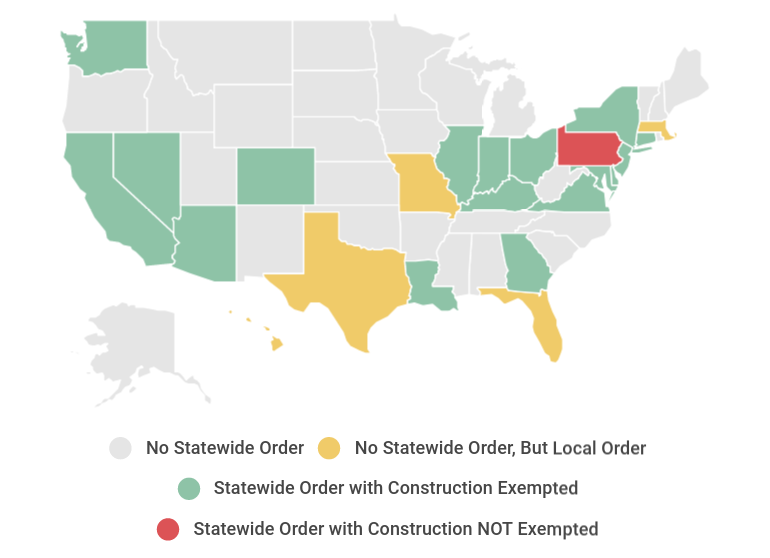
Texas exceptionalism (and not in a good way)

“You can’t manage what you can’t measure” 
This apocryphal quote, variously attributed to Deming or Drucker, has gotten a bad rap in management circles for its inherent cognitive tunneling.  In the case of the COVID19 pandemic. there’s a massive amount of truth since we’re essentially flying blind.  Especially in Texas (source: Texas Monthly)
Image

Friday, March 27, 2020

Politico: The next financial crisis: A collapse of the mortgage system

“The mortgage market is one of the many multiple complexly interconnected pieces of our financial system, so those assurances (note: bank-provided credit facilities) are really important, but I think the role of the government in being a reliable and available source of credit for the mortgage market and mortgage servicers during a crisis is even more important.” — Margaret Liu, Conference of State Bank Supervisors (CSBS) senior vice president and deputy general counsel.

Those in control seem to be busy fighting the last war, applying those lessons learned in blazing speed with insufficient consideration that mortgage servicing is now dominated by non-banks.  What was a very unpleasant drag to returns for the banks in the prior crisis is now an existential threat for the entire system this go-around.
The Maginot Line – 11 Fascinating Facts About France's Great Wall ...

Thursday, March 26, 2020

HEB > CDC/FDA/FEMA...

How did Texas-based HEB get the jump on COVID19? By reacting to the information coursing thru its supply chain early, by leveraging global partners in China, Italy to inform preparations, and by embracing community as a key constituency

Zillow’s coronavirus playbook

"On the call, Rich_Barton revealed that Zillow will slash expenses by 25% this year; freeze hiring across the company; cut nearly all marketing spend; and suspend home-buying through its Zillow Offers business."

Wartime CEO

Must read tweet stream from Stewart Butterfield of Slack (via Scott Galloway)


Title courtesy of Ben Horowitz. 

Monday, March 23, 2020

Coronavirus accelerating the digital transformation of house hunting

"Redfin saw a 494% increase in requests for agent-led video home tours last week... As of yesterday, 18.9% of tour requests made on http://Redfin.com were video-chat tour requests, up from 0.2% at the beginning of March"

More non-QM trouble

Angel Oak and Citadel Servicing have halted Non-QM lending.

Flagstar cutting back on warehouse lending

Flagstar Bancorp, one of the nation's biggest warehouse lenders to mortgage providers, has stopped funding most new home loans without government backing.

Non-QM and iBuying as canaries in the coalmine

Further sign of a liquidity crisis in the housing finance market - a system-wide retrenchment in Non-Qualified Mortgage originations with major originators in the segment shutting down production.

Those considering Non-QM loans risky and are saying "good riddance," are missing the forest for the trees as non-banks dominating housing finance rely on interim funding as working capital since they lack access to the permanent capital available to banks.

Together with iBuyers, which have suspended their purchases en masse, these two are the veritable tide pools of the housing finance ecosystem, teaming with innovation, yet most exposed when the tides turn. While it's comforting that the Federal Reserve Board is now deploying an unlimited checkbook towards quantitative easing, the administration's erratic actions and Trump's deep antagonism towards Powell is depriving the market of something just as critical - confidence.

This recalls the book "The Confidence Game" written 25 years ago at the zenith of the independent central banker with the author positing that "central banks are the sole institutions capable of maintaining a global system of checks and balances."

Wednesday, March 11, 2020

Creating an Innovation API to scale up collaborations

Great example of the Innovation API I’ve advocated for so that financial services incumbents can shape collaborations with #intech at scale in a mutually beneficial manner.

The rapid proof of concept (RPOC) was developed in 2019 to “to speed up how quickly the CIB could decide if it wanted to work with a fintech” from months to weeks.  Components include: streamlined documentation needs, standardized NDAs, “fintech-friendly” evaluation agreements, and synthetic datasets in an AWS sandbox.

"One of our goals is to partner more and work with the fintech community to build an innovative ecosystem" - Michael Elanjian, head of digital innovation at J.P. Morgan’s Corporate and Investment Bank.

Tuesday, March 10, 2020

Digital transformation of mortgages (v.Next)

“...the surging demand (for mortgages) will likely overwhelm parts of the process and all lenders' turn times will probably lengthen”

While most leading mortgage originators have invested in or partnered with fintechs to upgrade their digital mortgage capabilities, these “upgrades have primarily streamlined only the early stages of the notoriously complicated and paper-heavy mortgage process.” Processing, underwriting, appraisals, home inspections, and closings still involve substantial human effort.

How will we, as an industry, reconcile the strategic imperative to continue our digital transformation, which is still clearly in the early innings, with this bounty of production in a way that prioritizes customer experience?

Tuesday, February 25, 2020

HBR: Are Your Company’s Leaders and Data Scientists on the Same Page?

“Unfortunately, what’s far more common is misalignment between expectations at the top of the organization and the foundation of what data science can realistically deliver. The best mental picture of this dynamic is an inverted pyramid. The wide top reflects the C-suite’s oversized expectations for data science impact. The small point at the bottom represents the data science team’s current capabilities, which are often far more modest and develop over time.” (from HBR)

Saturday, February 22, 2020

Something fishy with Zillow's revenues

Great analysis by Mike DelPrete.  It’s as if an investment bank reported revenues based on the gross value of securities sold through its brokering business.  Another sleight of hand relates to ‘holding cost’ since the reported amount ‘excludes expenses incurred during the period that are not related to homes sold during the period.’  The good news is that Zillow sold 115 more homes than it bought in 4Q19; the bad news that ended 2019 having bought 2,198 more homes than it sold.  What’s clear is that the company’s balance sheet has changed dramatically, with Inventory ending the year at 13.6% of assets, up from 3.8% at 2018 year-end.  Since the $1.5B of credit facilities is already at 46% utilization, I’d keep a close eye on the velocity of homes inventory in 2020.  Zillow may discover that what they thought was a ‘shipping’ business was, in fact, a ‘storage’ business.

LendingClub's acquisition of Radius Bank

“The monoline marketplace lender model is a dead end for fintechs and they know it.”

Comprehensive analysis by Todd Baker on the LendingClub Radius Bank, hitting on all the issues that surfaced when we investigated making a push into personal loans a while back.

"It’s impossible to build a consistently profitable and resilient business without providing customers with a broader range of products and services--with their attendant revenue streams. There just aren't enough savings from automation to make up for lost revenues and financial intermediation costs."

Friday, February 21, 2020

Is Zillow in the shipping or storage business?

Much ink has already been spilled about the losses racked up by Zillow as it aggressively grows  revenues from its Homes segment.  Mike DelPrete further points to how the reported revenues are misleading because its basis is that of the home sale price.  It’s as if an investment bank reported revenues based on the gross value of securities sold through its brokering business.

Another sleight of hand relates to ‘holding cost’ since the reported amount ‘excludes expenses incurred during the period that are not related to homes sold during the period.’  The good news is that Zillow sold 115 more homes than it bought in 4Q19; the bad news that ended 2019 having bought 2,198 more homes than it sold.

What’s clear is that the company’s balance sheet has changed dramatically, with Inventory ending the year at 13.6% of assets, up from 3.8% at 2018 year-end.  Since the $1.5B of credit facilities is already at 46% utilization, I’d keep a close eye on the velocity of homes inventory in 2020.  Zillow may discover that what they thought was a ‘shipping’ business was, in fact, a ‘storage’ business.

Tuesday, February 18, 2020

More on The Economist's year of residential real estate...

"In the 1950s, 20% of households in a county moved each year. Today 9% do."  This one point about the decreased mobility of Americans may explain why The Economist seems to have made 2020 thus far its "Year of Residential Real Estate."  What’s evident is the publication sees real economic and societal costs from the ossification of “world’s biggest asset class,” abetted by government actions that have rendered an obsession for home ownership its “biggest economic policy mistake.”

The problem is that the US has some of the highest real estate commissions in the world, and antiquated "rules on commissions and data-sharing have so far kept fees higher than in other rich countries."

Thus begins the newspaper's the latest piece around real estate, about how "technology is poised to upend America's property market."

Sunday, February 16, 2020

Glengarry Glen Ross in Mortgages 2019

The mortgage sector rocketed to a close in 2019 with $2.4 trillion of total production (up 46% year-over-year).  The recent trends of increased concentration at the top and the rise of the non-bank originators continue, with the Top 25 accounting for nearly 60% of the market (up 2 points) and non-banks accounting for 57% of that cohort (up 7 points).

Glengarry Glen Ross"...first prize is a Cadillac Eldorado... Second prize is a set of steak knives. Third prize is, you’re fired.” (Alec Baldwin as Blake, Glengarry Glen Ross)
Just as important for the non-banks is the "Glengarry Glen Ross" nature of the competition.  In the past year, the top three non-banks (Quicken, PennyMac, United Wholesale Mortgage) accounted for 38% of the increased production amongst the entire Top 25, growing at 2.4x the rate of others in the cohort.

How did they do that?

Each of the top three non-banks have spent the better part of the past decade creating substantial technology platforms that seems to have able to mitigate the capacity constraints that have traditionally characterized US mortgage lending.  A 2018 study by the New York Fed ("The Role of Technology in Mortgage Lending") provides some some early intel on this topic.  In assessing the role of technology in mortgage lending, the study found that lenders whose business model incorporates "an end-to-end online mortgage application platform and centralized mortgage underwriting and processing augmented by automation" were able to "respond more elastically to changes in mortgage demand."

It further found that a doubling of application volume raises loan processing time by 13.5 days for traditional lenders, compared to only 7.5 for technology-enabled ("FinTech" in the study), with reduced denial rates,"suggesting that their faster processing is not simply due to credit rationing during peak periods."

The data set used in this study spanned 2010 through 2016, suggesting that these advantages would have increased substantially with the tech maturation of the past few years.

What does this mean for the rest?

Image result for grasshopper ant fableFocusing on the field of non-banks below the top three (the "herd") for the moment since banks view their mortgage units as a part of a larger portfolio and have manifold considerations aside from just maximizing mortgage production, what are these institutions doing to with this past year's unexpected bounty.  Which ones are playing the ant of Aesop's Fables fame, diligently preparing for the inevitable lean times to come?  Which ones are the grasshoppers, enjoying the bounty and living in the present?

Just as importantly, how can the herd seek to close on capabilities when the leaders have substantial head starts that have moved them far down the experience curve?

Disruption!


In my next piece, I will investigate how the herd can marshal disruption to close the gap since traditional means will only get them to an infinite "follow the leader" loop.

Thursday, February 6, 2020

Single family homes on their way out?!?!

Is it time to "accept the single-family home is outdated?"  Farhod Manjoo's pronouncement might seem a rather over-the-top reaction to the failure of SB50 for those outside the SF Bay area, but with situations like 2:30 AM shuttles out of Salida for morning shifts at the Tesla plant or Google shuttles providing a total of 4 million rides annually across an area the size of the New York City to Philadelphia corridor, I'd hesitate before calling him out as being histrionic.

Wednesday, February 5, 2020

Disrupting real estate brokering

Philadelphia-based Houwzer, a tech-enabled real estate brokerage & home services startup, raises $9.5 million from Edison Partners to fund geographic expansion in the Mid-Atlantic region.  Ventures seeking to disrupt the real estate brokerage business, which also include Fly Homes, Redfin and REX, have come a long way from the days when YHD Foxtons tried to reboot the space with low fees, leveraging technology for product and experience differentiation.  The challenge they face, is that these plays, as they internalize and optimize large portions of incumbent brokering capabilities, exist in the middle between those who seek to:
  1. Leverage readily available external antecedents, but exert substantial control (e.g., Homelight) on one end; and
  2.  Fully disrupt the incumbent model by inserting the company as counter-party into the real estate sell/buy transaction.(e.g., OpenDoor, Knock, Offerpad) on the other.
Is this middle defensible ground or is this no-man's land?

Monday, February 3, 2020

Is the US prepared for the Coronavirus?

"In 2018, the Trump administration fired the government’s entire pandemic response chain of command, including the White House management infrastructure.” (Foreign Policy)
According to Foreign Policy, the actions taken to essentially gut the reforms to epidemic response made by the Obama administration in the aftermath of the faults made apparent by our handling of the 2014 Ebola outbreak will likely impair our ability to react to the emerging likely pandemic in a coordinated manner.  These actions have included:
  1. Reducing $15 billion in national health spending and cutting the global disease-fighting operational budgets of the CDC, NSC, DHS, and HHS.
  2. Eliminating the $30 million Complex Crises Fund.
  3. Ordering the shutdown of the NSC’s entire global health security unit.  Pressured DHS epidemic team to resign.  “Neither the NSC nor DHS epidemic teams have been replaced.”
  4. Cutting the global health section of the CDC so “that much of its staff was laid off and the number of countries it was working in was reduced from 49 to merely 10.”
Moreover, the US Agency for International Development (US AID) has come under repeated fire from both the White House and Secretary of State Mike Pompeo. And while Congress has so far managed to block Trump administration plans to cut the US Public Health Service Commissioned Corps by 40%, the “disease-fighting cadres have steadily eroded as retiring officers go unreplaced.”

The administration’s actions on this front sound distressingly familiar, a government led by the “uninterested,” as chronicled by Michael Lewis’s book, The Fifth Risk.

...Or one where political machinations are primary drivers of action, as demonstrated by the imbroglio over the phantom Alabama leg of Hurricane Dorian.

Sunday, February 2, 2020

Facts about our housing supply explain high rents and home prices

Urban Institute's latest dissection of the US residential housing sector indicates that, essentially, we’re not creating enough housing stock and what is being created costs evermore to build and tends not to be the right type of stock.

figure 1

Friday, January 31, 2020

California falls short again (in housing reform)

As a follow-up to a recent post, California's Senate Bill 50, which would "dramatically increase homebuilding," falls short for the third year in the row, “opposed by state senators who said the measure took too much power away from local governments and failed to sufficiently address low-income housing needs.”  In other words, Scott Wiener's bill fell victim to a toxic stew of regulatory capture by entrenched interests and idealists making good the enemy of great.

Wednesday, January 29, 2020

Trust but verify - Coronavirus edition

The latest epidemic coming out of China has many highlighting the deadly inefficiencies of top-down authoritarian regimes.  As Nicholas Kristof puts it in his recent piece, "Dictators often make poor decisions because they don’t get accurate information."

Into this breach of trust... "BlueDot Inc a Toronto startup whose AI-driven health monitoring platform analyzes billions of data points... alerted its clients to the (coronavirus) outbreak on Dec. 31, well ahead of notifications from the World Health Organization and US Centers for Disease Control and Prevention"

How housing became the world’s biggest asset class

The Economist has been on a tear with regards to housing, the latest being a recent history of this asset class.

Some eye-opening nuggets...

  • "median American rent payment rose 61% in real terms between 1960 and 2016 while the median renter’s income grew by 5%"
  • "In 1940-2000 mortgage credit as a share of gdp across the rich world more than doubled"
  • "the rate of housing construction in the rich world is half what it was in the 1960s"

Tuesday, January 28, 2020

Rebuilding trust...

At a time when many are content with calling balls and strikes, Peter Kraus and Gregg Schoenberg are masters of delving into the second and subsequent order impacts of what transpires on the field of play, as evidenced by Peter's latest edition in his podcast series "Elephant in the Room" where the duo explore, among other things, trust and transparency in the financial markets, as well as fintech, ESG and asset management.

Monday, January 27, 2020

The Mandate of Heaven

The inimitable Charles Krauthammer, burdened by liberal enlightenment thinking, got China way wrong by inserting a phantom “People” element into “The Mandate of Heaven.” Three decades on, we may be about to see the sons of the Yellow Emperor contend with the very real “Heaven” of that term of art.

Saturday, January 25, 2020

Peeling the onion on ATTOM's latest pronouncement on the affordability of buying vs. renting

While it’s nice that buying is more affordable than renting in 53% of US counties, a population-weighted view gives a dramatically different story.  Buying wins in 31% of counties with over populations of over 500k and only 16% in counties where populations cross the 1 million threshold.

Thursday, January 23, 2020

Average US home seller profits hits another new high?

Average US home seller profits in 2019 hit record high...  A happy headline indeed, but also demonstration of the Rorschach test of real estate stats at the national level.
Post featured image
Home ownership tenure of sellers in Q4 2019 averaged 8.21 years, the highest since Q1 2000, roughly coinciding with the nearly 60% national home price index appreciation since Q1 2011, demonstrating the importance of good timing.
HPI Price by Segment
Moreover, the top 5 tenures were all counties in Connecticut (12.25 years+), a state where overall sale prices remain below the 2007 peak.

Saturday, January 18, 2020

Friday, January 17, 2020

Is home ownership really "The West's Biggest Economic Policy Mistake?"

“Far from shoring up capitalism, housing policies have made the system unsafe, inefficient and unfair.” The Economist makes the case that the West’s “obsession with home ownership” is its “biggest economic policy mistake,” undermining growth, fairness and public faith in capitalism.

Saturday, January 11, 2020

Making California livable again

According to The Atlantic, "California Senate Bill 50, winding its way through the state legislature again this month, could generate tens of thousands of new jobs and billions of dollars of new investment, reshaping the geography of the biggest state and solving a large chunk of the cost-of-living crisis the Trump administration has assiduously avoided addressing by, essentially, forcing California communities to allow more construction."

 "Based on the housing-unit-to-population ratio in similarly wealthy and urban states, such as New York and New Jersey, California is short 2 million to 3.5 million housing units. (California has 358 homes per 1,000 people, whereas New York and New Jersey each have more than 400.) Right now, the state ranks 49th in units per capita, behind only Utah."

Monday, December 30, 2019

The hidden costs of taking cash out of your home

Nearly 60% of cash-out refinancings in 2018 came with higher interest rates (WSJ)
The recent WSJ article on American consumers refinancing at higher rates to take equity out of their home is yet another indication of the product-market mismatch in residential real estate financing.

No alternative text description for this image
Paul Thompson, the particular consumer in the piece, replaced his five year-old 4% mortgage with a 4.625% mortgage, taking out $30,000 in the process.  Some back-of-the-envelope calculation show that Paul will be paying $146,530 over the life of the new loan for the opportunity to take out $30,000 in equity.  I didn't account for time value of money or mortgage interest deductibility, but it seems that Paul will need a period of macroeconomic hyperinflation for this to make sense financially.

Showing my work (assumptions)
  • He initially took out $350,000 for 30 years; total payments would have been $601,543
  • Assuming 60 periods in, he would have paid down $33,433 in principal and $66,824 in interest (totaling $100,257)
  • Since he took out $30,000 in equity, I'm further assuming the new mortgage balance will be $350,000
  • He will have total principal and interest payments of $647,816 for his new loan.
  • [New Loan: $647,816] - ([Old Loan: $601,543] - [Old Loan Paid Down: $100,257]) = $146,530

Wednesday, December 11, 2019

A little perspective please (when it comes to Millennial housing preferences)

Do half of all millennial home buyers really view “two story entry foyers” as “essential” or “desirable” as detailed in "What Home Buyers Really Want (2019 Edition)" published by the National Association of Home Builders.   While I applaud NAHB’s efforts to better understand the generation, this is a bit much, especially when a longitudinal comparison shows only a fifth of the boomer set as having the same preference.

Is this manifestation of the the false sense of intimacy conveyed by the cohort’s preferred methods of discovery (Zillow, HGTV...), combined with their relatively late start into the realities of home ownership?  One may deem this the “Mrs. Fletcher” conundrum, where the digital proxy, however authentic-seeming, is far from real.

Might the solution be to help home buyers better appreciate both the qualitative and quantitative value drivers that go into housing to understand the tradeoffs inherent in home ownership?

Tuesday, December 10, 2019

Will iBuyers love LA?

Leading iBuyers Opendoor, Redfin and Zillow are all entering Los Angeles, the second-largest housing market in the US.  Will their valuation algorithms be up to the challenges of this significantly more heterogenous and expensive real estate market?  Tune in...
No alternative text description for this image

Wednesday, December 4, 2019

Areas of highest millennial concentration seeing lower levels of home building

NAHB reports that the 25% of counties with highest millennial concentration saw construction growth rates for single-family and multifamily home building at generally lower rates "than the remaining 75% of counties. These statistics point to a growing geographic mismatch between younger households with expanding housing demand and where construction is expanding.

Friday, November 8, 2019

Blockchain as Liquid-Plumr for financial market pipes

WSJ reports... “That two-day delay comes with various costs. Banks collectively set aside tens of billions of dollars in capital to cover the risk that firms elsewhere in DTCC’s network will fail before the trades settle.

There are also separate systems at each big bank, as well as at DTCC itself, that track what different market participants are expected to pay or deliver at settlement time. Bankers say this is inefficient and results in errors when systems disagree with each other.

‘We are constantly reconciling that data,’ said Jeffrey Rosen, a New York-based managing director at Société Générale. ‘That is hugely expensive. While we’ve built tools to do it efficiently, it would be better not to do it.’”