Friday, August 28, 2020

Has the Mid-Atlantic been gaining?

While The Brookings Institution piece focuses on how the Sunbelt’s coronarvirus surge is stalling that region’s economic recovery, I was just as interested by how the illustration of the change in volume of job postings in July seems to show that the big scale gainers are the Mid-Atlantic region, especially the New Jersey-Virginia coastal corridor, and Florida.


Sunday, August 23, 2020

Jumbo mortgage rates... A jumbled mess...

“The Mortgage Bankers Association’s Mortgage Credit Availability Index, a formula designed to gauge access to a variety of mortgage products, shows consumer access to jumbo loans was 60% lower in July than it was the year prior.”

Saturday, August 22, 2020

Top counties seeing remote job growth

According the National Association of REALTORS®, these counties are seeing the most significant growth in remote jobs:

  1. Forsyth County, Ga.
  2. Douglas County, Colo.
  3. Los Alamos County, N.M.
  4. Collin County, Texas
  5. Loudon County, Va.
  6. Hamilton County, Ind.
  7. Williamson County, Tenn.
  8. Delaware County, Ohio
  9. Dallas County, Iowa
  10. Wake County, N.C.

Monday, August 17, 2020

Is New York Dead?

“I could go out at night to my favorite restaurants and then see my favorite performers perform. I could go to the park and play chess, see friends. I could take advantage of all this wonderful city has to offer.  No more.”

James Altucher being morose about the prospects of The Big Apple.  One only has to review the projections baked into the 2019 NYC Annual Report on Tax Expenditures to be assured that his fears are mathematically provable.

Yet, I’ve witnessed the City’s attraction to my college-bound son, uncolored by legacy notions, through his several visits this summer.  The enjoyment of exploring the neighborhoods with friends, the pedestrian pleasures of street food, the magic of a tranquil moment sitting aside a tree in Central Park...  NYC will be back, and I’m optimistically hoping that I won’t have to subsidize my son’s future life there as much.

Wednesday, August 12, 2020

Q: How many loans are in active modification or in some form of hardship relief?

With the heightened levels of distress in the mortgage market, you’d “hope” to get a straight answer. Recent analysis showcase how the myriad participants of mortgage-backed securities and their inconsistent methods of tracking/reporting conspire to obscure this essential metric. “Hope” indeed seems to be the strategy.

In a sample 900 loan non-QM securitization, the different participants had pegged the number of mortgages in modification variously at 233, 41, 74 and 261. Given the implications, you’d think it would be somebody’s job to get this right.

Props to dv01 for a dumbfoundingly clear illustration of the faults of this Rube Goldbergian construct. If you’re wondering why Intercontinental Exchange acquired Ellie Mae - giving Thoma Bravo a ~3x return after 16 months in the process - after picking up MERS in 2018, or why Mike Cagney is laboring on Provenance and Figure, this may be a clue.

Tuesday, August 11, 2020

July FNMA HPSI: It's a seller's market

July's update on Fannie Mae's Home Purchase Sentiment Index reflect a seller's market, with 53% of Americans believe it a good time to buy a home, down 8% from June, while 45% believe it a good time to sell, up 4% from last month.

Wednesday, July 29, 2020

US Census Bureau: 2Q homeownership rate up 260bps q/q...

 Headline: U.S. Census Bureau reports 2Q20 homeownership rate soar 260 bps to 67.9%, the highest since 3Q08.

Consideration: Using an estimated US housing stock of 135mm homes, that’s a +3.5mm move over a single quarter. The bureau did note that “a change in methodology that could have impacted the numbers. Because of the COVID-19 pandemic, in-person interviews were suspended and most of the survey was conducted by telephone.”

Even the generally cheerful National Association of REALTORS® chief economist Lawrence Yun noted, “Usually homeownership data moves at more of a glacier-slow pace, so to see a sudden move like this was quite surprising. Some of this increase could be due to the change in data measurement.”

The second quarter ended with a strong yet not uniformly blowout June, with a 13 year high in new home sales and a +20.7% m/m in existing home sales boosted by an 18.2% y/y drop in existing home supply. While I’m upbeat about 2Q20 residential housing trends, I’d keep the champagne on ice until we get further details about the impact of the new methodology.

Thursday, July 23, 2020

WSJ: Existing home sales up 20.7% month-over-month

More appropriate headline: “Existing home sales up 20.7% month-over-month from a coronavirus-induced trough.”

A better indicator of the strength of housing is that, while seasonally-adjusted annual sales of existing homes was down 12.4% year-over-year, the supply of those same homes was down 18.2% from a year ago.

Looking ahead, assuming you believe that housing trends will revert to normal, reasonable given the size of Millennial/Gen-Z cohort just getting into their housing formation years, we may be seeing a "squeezing of the balloon" - the air gets pushed down for now, but doesn't disappear.

Sunday, July 19, 2020

Urban Institute: We need a Federal liquidity facility for government servicing

Amidst the generally positive news on CARES Act mortgage forbearance (Mortgage Bankers Association “reported that only 7.8% of mortgage loans nationwide were in forbearance as of July 12, equating to roughly 3.9 million homeowners. It represents the smallest share of loans in forbearance in more than two months.”) this Urban Institute piece spotlights the risks attendant with Ginnie Mae mortgages, with borrowers much more in the cross-hairs of the coronavirus-driven recession from economic perspective and with a structure that places more risk on the issuers.

Saturday, July 18, 2020

The Disruption We Need is Not in Technology

Call to arms on disruption by my friend Kelsey Weaver, co-founder of Neocova as she seeks to bring the Big D to community banking...

scarcity = dependence = control vs abundance = choice = freedom

Saturday, July 11, 2020

WSJ: For pensions, difficulty of valuing real estate during a pandemic

Valuing a wide-ranging basket of real estate assets, always difficult, has been made tougher with the divergent near-term impacts emanating from the coronavirus pandemic, not to mention the prospect of a long-term, sustained transformation consumer behavior.

“The scarcity of tra­di­tional data points means es­ti­mated val­ues may not price in the true im­pact of the pan­demic, said Christy Fields, a man­ag­ing prin­ci­pal with con­sul­tant Meketa In­vest­ment Group.”

With US public pensions already facing a shortfall estimated at greater than their entire $4Tr holdings, properly marking the 6.1% share in real estate (+60% over the past 13 years) takes on added import.

Monday, June 29, 2020

Redfin: 27% of buyers intend to relocate

“Redfin notes that page views of homes for sale in towns with fewer than 50,000 residents saw traffic rise 87% year over year in May. That is nearly four times the 22% yearly increase in page views of homes in cities with more than 1 million residents.”

Redfin further reported that a “record 27% of home searchers at its site looking to move to another metro area in April and May.”

Premature to call a trend since it’s like predicting global relocations by tracking viewership of House Hunters International, but, definitely, watch this space...

Friday, June 26, 2020

Urban Institute: June chart book

Another series of excellent visualizations courtesy of the June Housing Finance Center Chart Book from the Urban Institute.

(1) The sudden jump in mortgage origination profitability during the second quarter, to the highest levels on record.

No alternative text description for this image

(2) The magnitude and rapidity of the Federal Reserve Board Agency MBS purchase program since March

 No alternative text description for this image

Tuesday, June 16, 2020

GSE's (potential) move out of conservatorship

If the Trump administration could be commended for consistency and the ability to maintain focus, top on that list would be GSE reform.  Word has come that both GSE's have retained banks as advisors (Morgan Stanley by Fannie Mae and JP Morgan by Freddie Mac) for the purpose of “developing plans to boost capital, evaluating market impacts and timing and analyzing valuation” with the “aim of returning Fannie and Freddie to the private market and facilitate the road map out of government control.”

Hence, it's a good time to bone up on the myriad sticky issues around any move out of conservatorship for the GSE's. Former Freddie CEO Don Layton's post in the Joint Center for Housing Studies blog late last year would be an excellent place to start. In it, he refers to a paper that includes a make-believe memo with fourteen considerations to an investment banking exec who would conceivably be interested in assuming the lead underwriter role.  

One notable point - "The two GSE's together will need common equity well in excess of $100 billion between them.." By comparison, Saudi Aramco holds the title for the largest IPO in history at $25.6 billion.  Clear incentive for this massive job.  

Saturday, June 13, 2020

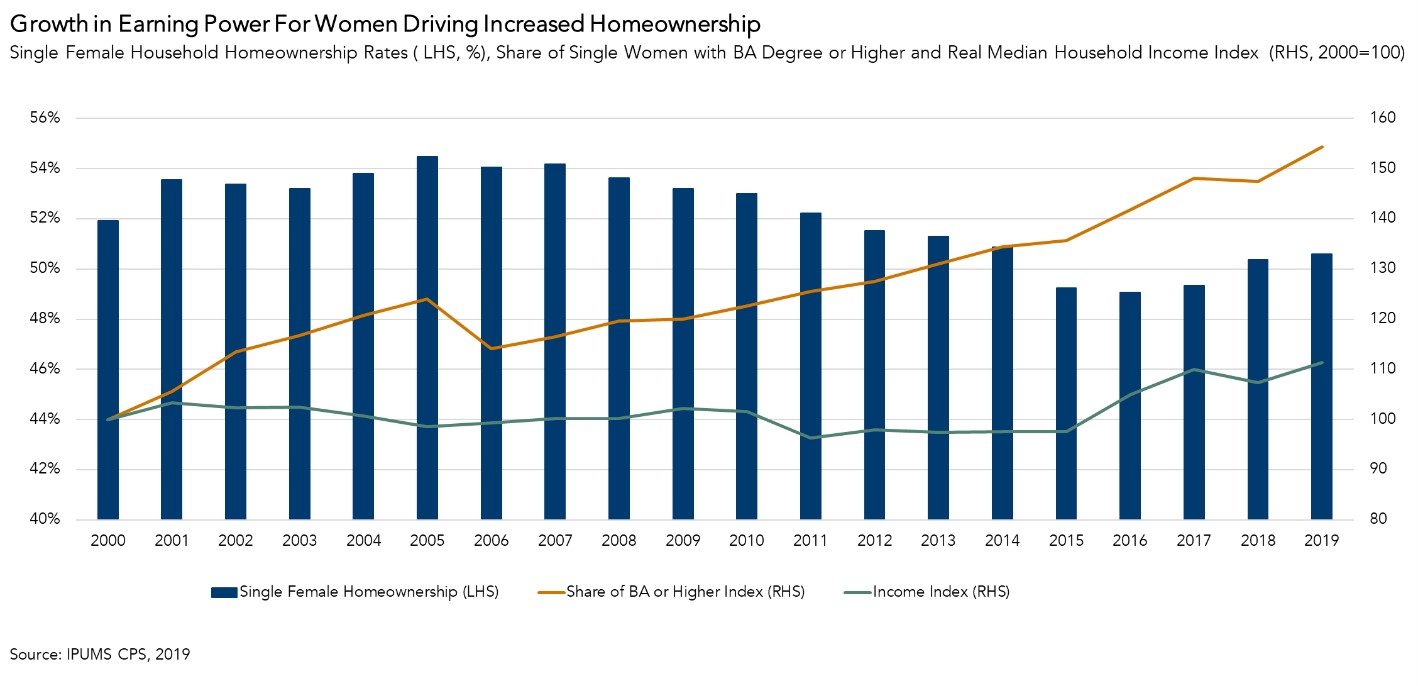
Single women increasingly becoming homeowners

Single millennial women, better educated on average than their male counterpart, are more likely to own homes (+2.2% vs single millennial men) despite lower earning power. Given that home ownership is a major driver of wealth creation, that latter gap may soon be closing.

Growth in Earning Power for Women Driving Increased Homeownership Chart

Friday, June 12, 2020

Homeowners are doing OK thus far...

As we receive word of further tailwinds in the housing sector, with the Mortgage Bankers Association reporting that purchase mortgage applications rose to the highest level in over 11 years, here’s a revealing chart that shows how homeowners have thus far under-indexed in the pain riven by this coronavirus driven recession (Source: Brickman, David of Freddie Mac and USC Lusk Center for Real Estate)

No alternative text description for this image

Tuesday, June 9, 2020

A bright spot mortgage forbearance, but...

While nearly 9% of US mortgage holders are in forbearance,  it's markedly less than Mark Zandi's prediction of 30% two months ago. And it's dropping, albeit by a minuscule 34k w/w as of June 2.

The next big data points will be: (a) the percentage of homeowners in forbearance who continue to make a payment in June - this statistic was 46% in April and 22% in May; and (b) the portion of homeowners with expiring 3-month forbearance plans who choose to extend.

Of course, we'll all be awaiting the potential continuation CARES Act, set to expire at the end of July, especially the extra $600 in weekly unemployment benefits, which has kept many afloat.